
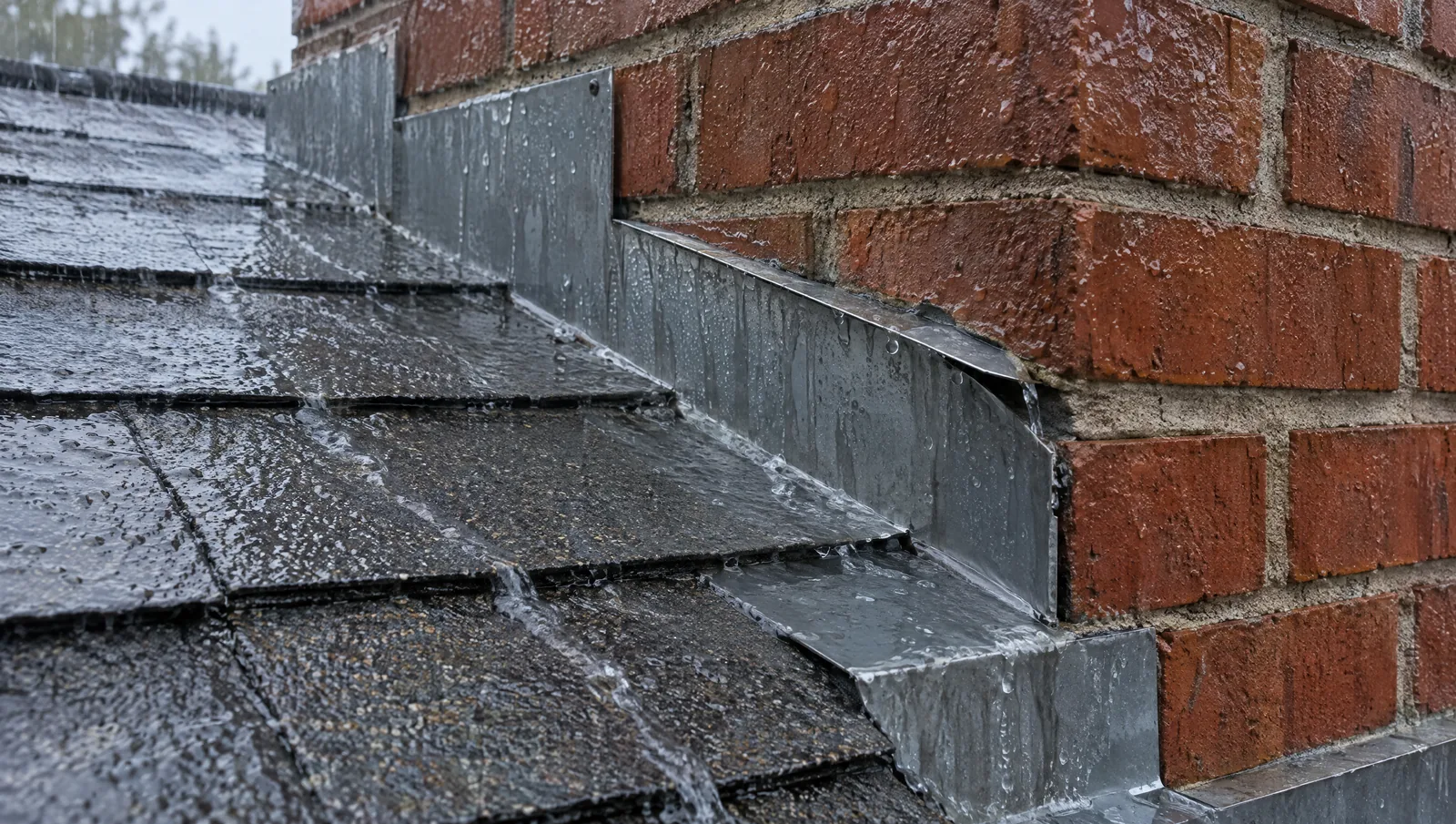
A chimney that leaks only when it rains is almost always letting water in at one of four places: the flashing where it meets the roof, the crown on top, the open flue, or the brick and mortar itself. Flashing is the most common culprit. Each one leaves different clues, so you can often narrow it down before anyone climbs a ladder.
The four places rain gets in
The flashing
Flashing is the metal that seals the joint between the chimney and the roof. Step flashing is woven in with the shingles along the sides, and counter flashing is set into the mortar joints of the brick and folds down over it. When the counter flashing pulls out of its joint, when old roofing tar dries and cracks, or when the metal rusts through, water runs down the outside of the chimney and into the attic or the ceiling below.
The crown
The crown is the concrete slab across the top of the chimney, and it sheds water away from the brick. Crowns crack with age, and many older ones were never more than a thin layer of mortar spread across the top. Water that gets through a cracked crown soaks down into the masonry and can show up far below, sometimes days later.
The open flue
A flue with no cap is a straight pipe for rain. Water lands on the damper or the smoke shelf, rusts the metal parts and drips into the firebox. A cap whose mesh has rusted away does almost the same thing.
The brick and mortar
Brick absorbs water, and worn mortar joints let in even more. In a long, soaking rain, a chimney with tired masonry can take on enough water to seep through to the inside wall, especially where the chimney passes through the attic.
Clues that point to the source
- Stains on the ceiling or wall where the roof meets the chimney usually mean flashing.
- Water in the firebox or a rusty damper points to the top: a missing or damaged cap, or a cracked crown.
- A leak that appears only when rain is blown from one direction often means water is entering on one face, through flashing or porous brick on that side.
- A leak that shows up after a long, steady rain but not a short storm suggests the masonry is soaking through.
- Water pooling on the uphill side of a wide chimney may mean a missing cricket, a small peaked roof section that splits water around the chimney. Building codes generally call for one when a chimney below the ridge is more than 30 inches wide.
When the water is not rain at all
Some leaks are really condensation. Exhaust from a gas furnace or water heater holds a lot of water vapor. If the flue is too large or too cold, that vapor turns to liquid inside the chimney and seeps out as damp patches or brown stains, often in the basement or near the appliance connection. The giveaway is timing. Condensation shows up when the heat is running, whether or not it has rained. That problem is solved with a properly sized liner, not new flashing, and it is covered in our article on how to tell a chimney liner is failing.
What you can check without climbing
Stay off the roof. From the yard, a pair of binoculars shows a lot. Look for metal flashing that has lifted or bent, dark streaks of tar or caulk along the base of the chimney, a cap that is leaning or gone, and chunks of crown or brick in the gutter. Inside, check the attic with a flashlight during a rainstorm. Water running down the rafters beside the chimney is a strong sign the flashing is at fault. Note where the stain is and what the weather was doing each time. That record saves time when the chimney is looked at.
Fixing it so it stays fixed
Caulk and roofing cement are the usual quick fixes, and they rarely last more than a season or two because they crack as the chimney and the roof move. A lasting flashing repair means new step and counter flashing, with the counter flashing cut into the mortar joints, and a cricket added where the chimney is wide enough to need one. Our chimney flashing repair page explains how that work is done. If the source turns out to be the crown, the cap or the masonry, those repairs are covered under chimney repair. Quite often there is more than one source, so it pays to fix them together while the roof is already being worked on.
Water coming in by the chimney?
We will trace where it enters and fix the source, not just the stain. The estimate is free.
Chimney flashing repair Get a Free EstimateMore reading: what spalling brick means · signs of a failing liner