
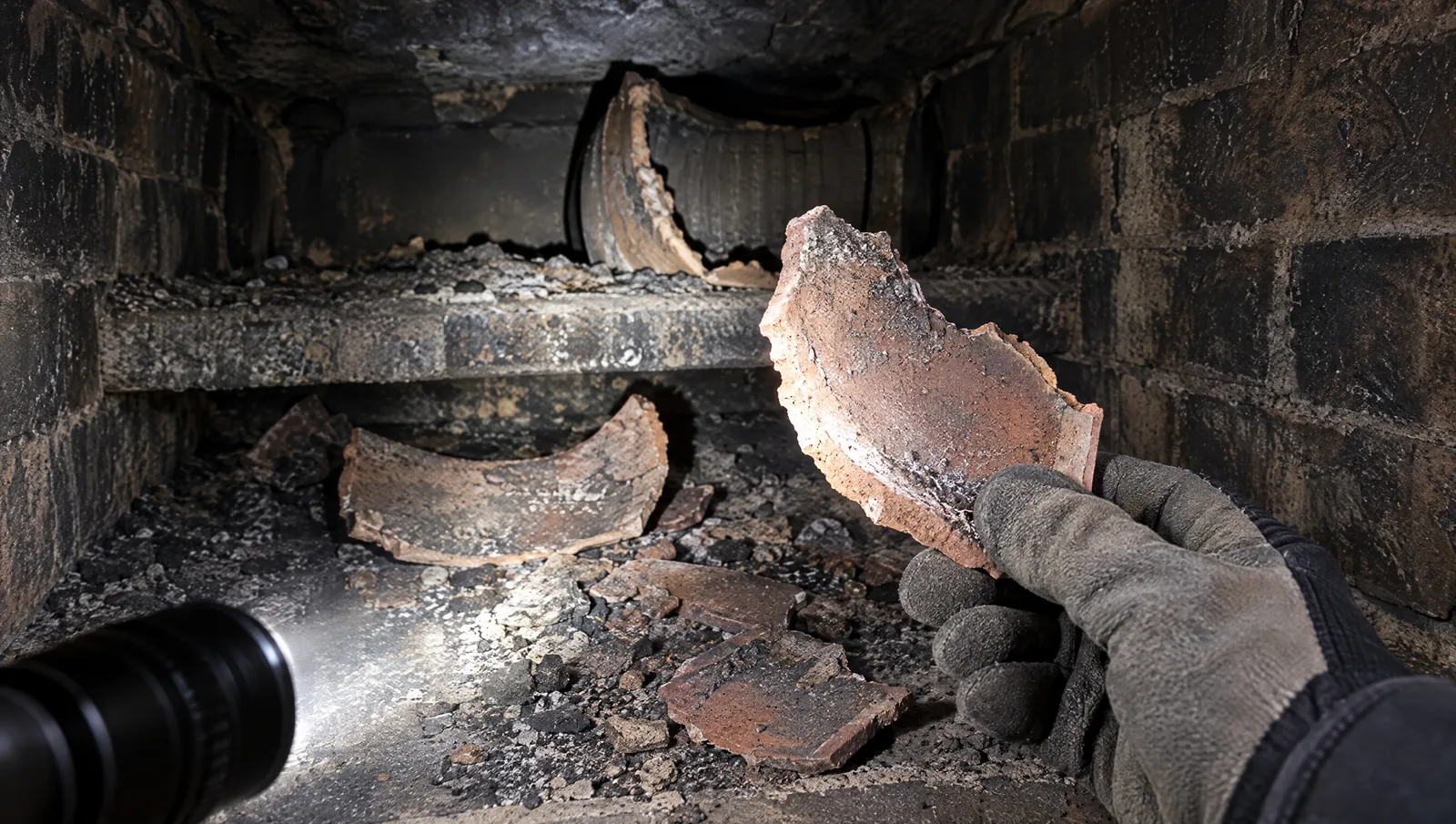
A failing chimney liner rarely announces itself with one big symptom. More often it shows up as small things that are easy to blame on something else: flakes of tile in the fireplace, a smell that hangs around after a fire, rust streaks near the water heater vent. The short answer is that you can spot some warning signs yourself, but the only way to know for sure is to look inside the flue with a camera. This article walks through both.
What the liner is there to do
The liner is the inner wall of the flue. In most older homes it is a stack of square or rectangular clay tiles set inside the brick. Newer and relined chimneys may have a stainless steel liner, or a cast-in-place lining poured against the old flue walls. Whatever the material, the job is the same. It keeps heat away from the wood framing near the chimney, it keeps acidic exhaust off the brick and mortar, and it gives smoke and gases a smooth, correctly sized path out of the house.
When the liner cracks, shifts or crumbles, all three of those jobs suffer at once. Heat can reach framing, moisture and acid can soak into the masonry, and the draft can weaken so exhaust lingers.
Signs you can notice from inside the house
- Tile shards in the firebox. Thin, curved pieces of orange or tan terracotta on the smoke shelf or the hearth usually come from a clay liner that is breaking up. Shiny black flakes are more likely creosote.
- Grit, rust or white crust at the base. Open the cleanout door in the basement if there is one. A pile of sandy debris, heavy rust on the door, or a white powdery crust points to moisture and acidic condensation inside the flue.
- Damp brick indoors. A chimney breast that stays damp in the attic or basement, even in dry weather, can mean condensation is soaking through a damaged liner.
- A fireplace that suddenly smokes. If the fireplace drew well for years and now spills smoke into the room, broken tiles or debris may be narrowing the flue.
- Exhaust smells near the furnace or water heater. A sharp or sour smell, soot around the draft hood, or a carbon monoxide alarm are signs that gases are not leaving the way they should. Treat any CO alarm as urgent and get everyone outside first.
Signs that only show up on camera
Many liner failures are invisible from the room. A camera lowered down the flue shows things a flashlight cannot reach:
- cracked tiles, often split up the middle after a very hot fire
- open or missing mortar joints between tiles, which let heat and smoke reach the brick behind them
- offset tiles that have slipped out of line
- a glazed, tar-like coating that suggests the flue once had a chimney fire
- scaling or pitting on the inside face of the tile from years of gas exhaust
This is why a camera run is part of a Level 2 chimney inspection. It turns a guess into a recording you can watch yourself.
Why liners fail in the first place
Clay tile handles steady heat well but does not like sudden change. A fast, hot fire in a cold flue can crack tiles because the inside face heats much faster than the outside. A chimney fire does the same thing in seconds, which is why tiles are so often found split after one.
Gas appliances cause a slower kind of damage. Their exhaust carries a lot of water vapor. In an oversized or cold flue, that vapor condenses on the tile and mixes with combustion byproducts into a mild acid. Over many winters it eats at the mortar joints and the tile surface. The risk rises when a furnace is swapped for a high-efficiency model that vents out a side wall, leaving the water heater alone in a flue that was sized for two appliances.
Age and settling play a part too. Mortar joints dry out, the house moves a little, and tiles slowly drift apart.
Repair or replace?
A single damaged tile near the top can sometimes be dealt with, but most clay liners cannot be fixed tile by tile because the tiles are sealed inside the brick. The usual answer is a new liner: a stainless steel liner sized for the appliance, or a cast-in-place lining when the flue shape or the fireplace calls for it. Our chimney liner replacement page covers how each option works and which appliances each one suits.
What to do if you suspect a problem
Stop using the fireplace until the flue has been looked at. If the concern is a furnace or water heater flue, make sure your carbon monoxide alarms work and have the system checked soon rather than waiting for spring. Write down what you noticed and where, keep any tile pieces you found, and have the flue inspected with a camera so the decision rests on what is actually inside the chimney.
Worried about your liner?
We can run a camera down the flue and show you what is inside. The estimate for any liner work is free.
Chimney liner replacement Get a Free EstimateMore reading: when a Level 2 inspection is needed · shared venting in two-family houses