
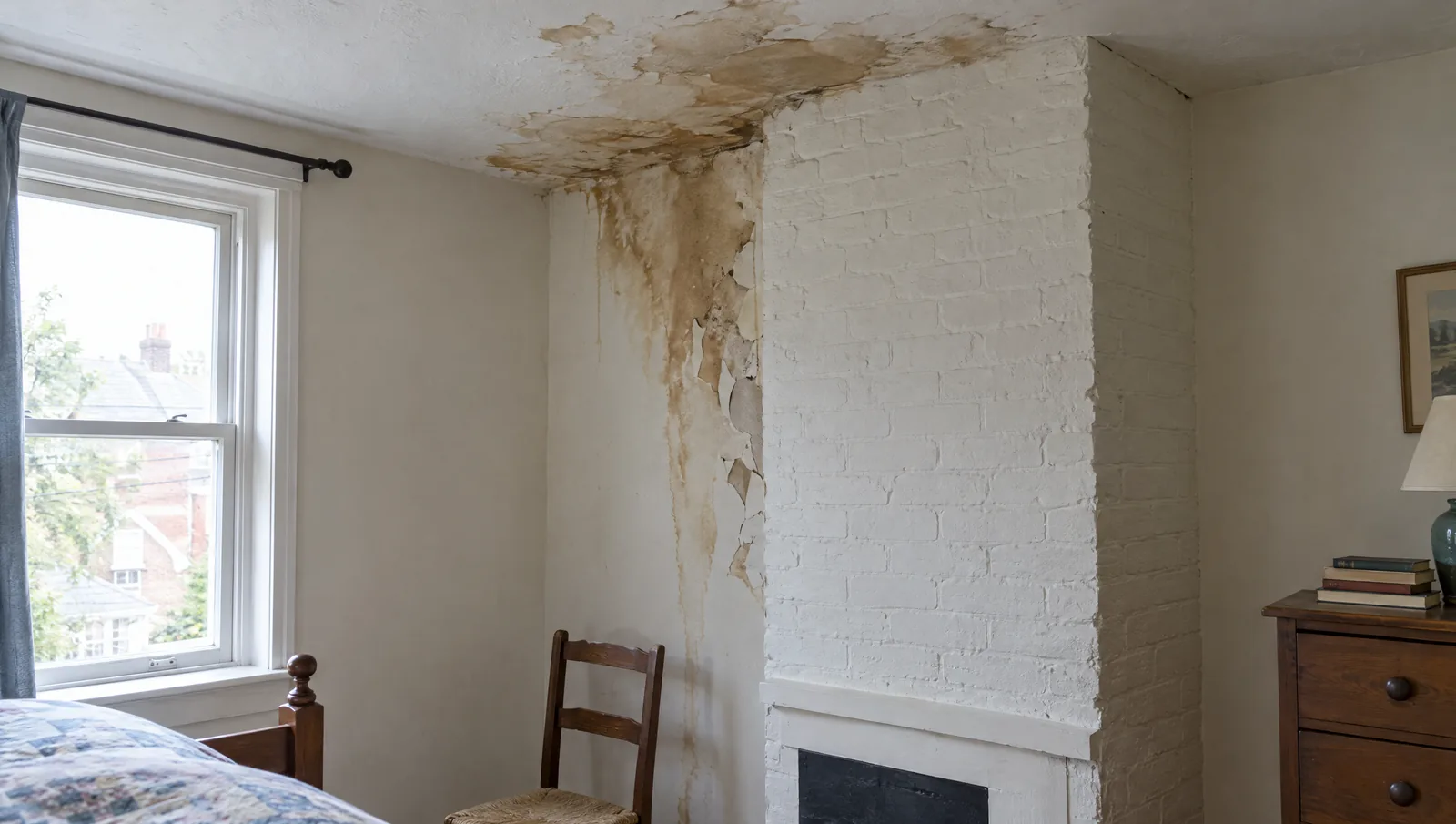
Most chimney problems are slow. A crack opens a little more each winter, a cap rusts a little further, and nothing looks urgent until water shows up on the ceiling. Knowing the early signs lets you fix a small problem while it is still small. Here are the ones worth acting on, roughly in the order people notice them.
1. A stain on the ceiling or wall beside the chimney
Brown or yellow marks next to the chimney breast mean water is getting past the chimney somewhere above. The usual suspects are the flashing where the chimney meets the roof, a cracked crown on top, or a missing cap letting rain straight down the flue. The shape of the stain helps. A stain that follows the roof line points to flashing. One that appears inside the firebox points to the top of the chimney.
2. Bits of concrete or brick on the roof or in the gutter
Grey chips are usually pieces of the crown, the concrete slab that caps the masonry. Red flakes are brick faces popping off. Either way, the top of the chimney is breaking down and letting water in, and it will get faster once water can freeze inside the cracks.
3. A rusted, bent or missing cap
The cap keeps rain, leaves and animals out of the flue. Once its mesh rusts through, birds and squirrels can nest inside, and a blocked flue can push smoke and exhaust back into the house. A cap is one of the cheapest parts of a chimney to replace.
4. A damper that sticks or will not seal
If the room near the fireplace feels cold in winter, the damper may not be closing. If smoke spills out when you light a fire, it may not be opening fully. Rust and heat warp old steel dampers. A top-sealing damper at the top of the flue is a common replacement.
5. White staining on the brick
A chalky white bloom on the outside of the chimney is efflorescence. It is salt left behind as water moves through the masonry and dries on the surface. The stain itself is harmless, but it shows that the brick is staying wet, and wet brick is what freezes and cracks.
6. Flaking brick and crumbling mortar
When the face of a brick pops off, the term is spalling. When mortar turns sandy and falls out of the joints, the brick is losing its support. Both are covered in more detail under chimney masonry repair, and both are easier to fix early than late.
7. Smoke or smell problems
A fireplace that smokes, or a sharp campfire smell on humid days, often means creosote buildup or a draft problem rather than a broken part. A sweep usually solves it. If it comes back right after a sweep, the cause may be the flue size, the cap or the smoke chamber.
8. A chimney that leans or has a gap at the wall
This one should not wait. A chimney pulling away from the house or leaning above the roof has a structural problem, and loose masonry can fall. It usually means a partial or full rebuild.
What to do next
Write down what you have noticed and when, and take a photo if you can do it safely from the ground. Then have the chimney looked at before the next heavy rain or the next fire. Most of these problems are a single repair on a single part, and our chimney repair page explains what each one involves. Catching them in the fall, before the first fire of the season, usually gives you the most choice about timing.
Seeing one of these?
We will look at the chimney and tell you what it needs. The estimate is free.
Chimney repair Get a Free EstimateMore reading: why a chimney leaks when it rains · what spalling brick means