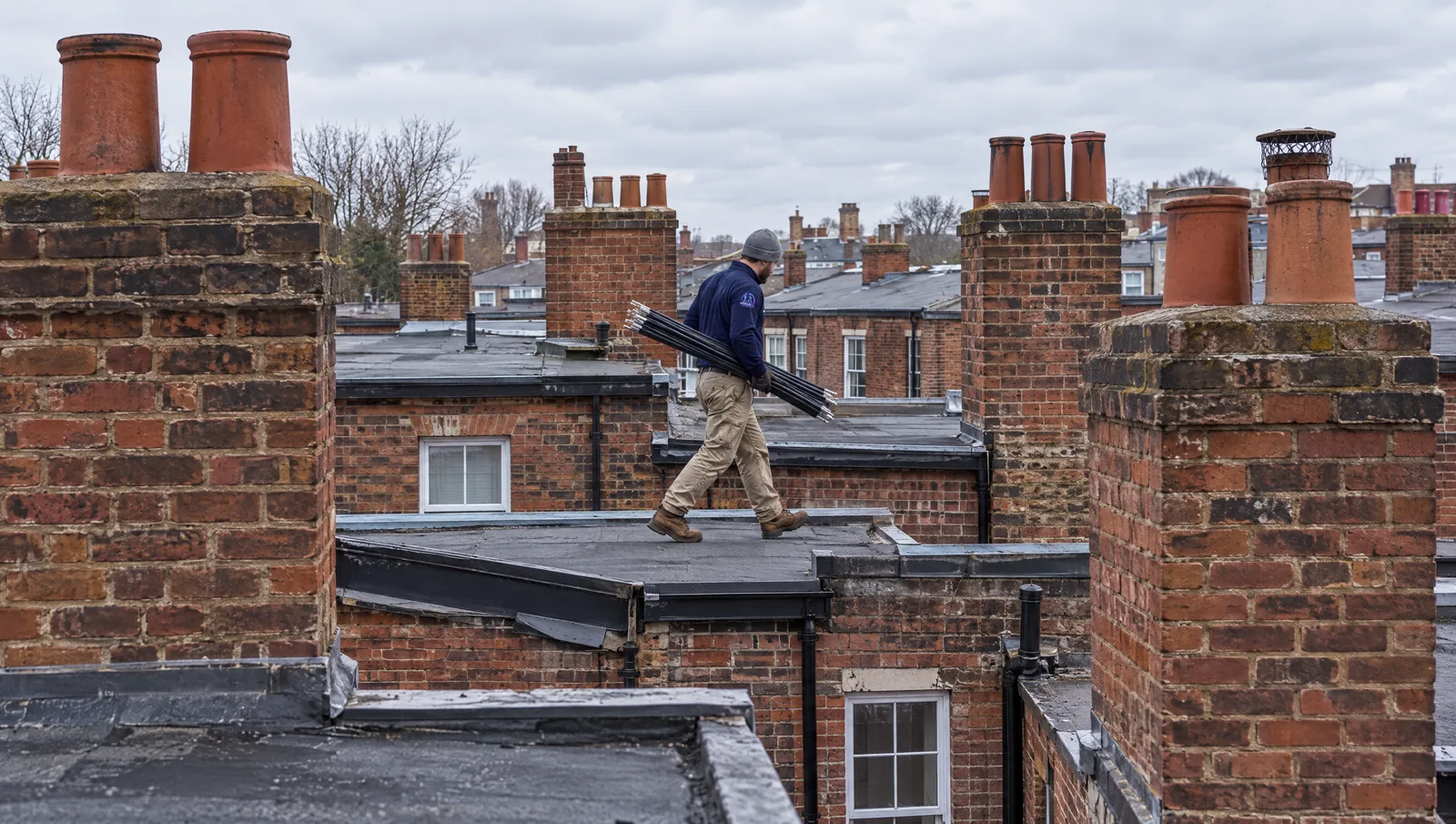
When houses stand a few feet apart, or share a wall, a chimney is no longer a private matter. Smoke and exhaust can drift into the house next door, a loose brick can fall into a narrow walkway, and a fire that starts in one flue can threaten more than one family. In East Newark, where homes sit very close together, the safety checks are the same as anywhere else. The stakes are simply higher.
How tightly built East Newark is
East Newark is the second-smallest municipality in New Jersey by total area, roughly an eighth of a square mile. At the 2020 census about 2,594 people lived there, a density of more than 25,000 residents per square mile, among the highest in the state. The borough had 920 housing units on that small footprint. The Passaic River runs along its western edge, with Kearny to the north and Harrison to the south and east.
The borough has a long industrial past, too. The Clark Thread Company moved its mills here in 1875, and the brick mill complex beside the river, built between 1875 and 1910, is now a National Historic Landmark district. In 1888 a magazine noted that the Clark Thread works had the tallest chimney in the country. The homes around it are far more modest, but an older chimney of any size deserves a careful look.
Four risks that grow with close neighbors
1. Smoke and exhaust drifting next door. A chimney that ends below the roofline of a taller house beside it can blow smoke straight at that house's windows, vents or air conditioner. The same goes for the exhaust from a gas furnace or water heater. A short chimney beside a taller building can also suffer from downdraft, which pushes exhaust back into your own home.
2. Fire spreading between buildings. Sparks and embers from a wood fire can land on a nearby roof, and a chimney fire inside a cracked flue can reach wood framing. Where two homes share a wall, the framing of both may be close to the masonry.
3. Falling masonry. A loose brick or a chunk of crown that drops from a roof into a narrow gap between houses is a hazard for anyone walking there, and it can damage a neighbor's roof or siding on the way down.
4. Shared and hidden problems. In attached homes, a chimney may sit on the party wall or run close to it. A crack in the flue liner can let smoke or carbon monoxide leak into a space neither household can see.
A safety checklist for East Newark homeowners
- Carbon monoxide alarms on every floor, including the basement where the furnace is, and near sleeping areas. Test them monthly. If neighbors share a wall with you, it is worth mentioning that they should have them too.
- Look up from the street. Check whether your chimney top is lower than the house beside it, and whether you can see missing mortar, leaning brick or a damaged cap.
- Keep the flue lined and sized for its appliance. An old unlined flue with a modern gas appliance attached is a common source of hidden exhaust leaks.
- Burn only dry, seasoned wood if you use a fireplace, and never burn trash or cardboard, which send up more sparks.
- Keep the cap in good shape. A cap with spark-arrestor mesh helps keep embers from landing on nearby roofs.
- Talk to the neighbor before major work. Repairs at the top of a chimney often need access over or beside the next house.
What an inspection looks for in a tight space
A standard inspection covers the accessible parts of the chimney: the firebox, damper, visible flue, cap and crown. In closely built homes the most important problems are often in the parts you cannot see, such as a cracked tile behind a shared wall or a gap where the flue passes through floors. A Level 2 inspection uses a camera to look at the full length of the flue. It is required under the NFPA 211 standard when a home is sold, when an appliance is changed, or after a chimney fire or other event that may have damaged the system. A Level 1 inspection is free with us, and a Level 2 inspection is $350.
If the top of the chimney turns out to be in poor shape, the inspection findings decide the repair. Our chimney masonry repair page covers repointing and brick replacement, and a flue that is cracked or missing usually means a new liner.
Getting started
If you are not sure when your chimney was last inspected, or a neighbor has mentioned smoke, start with an inspection before the heating season. Our East Newark chimney sweep page explains how we work in the borough, and you can reach us at (973) 786-9077.
Want a safety check on your chimney?
We will look at the flue, the top of the chimney and anything near your neighbors' walls and windows. The estimate is free.
Chimney sweep in East Newark Get a Free EstimateMore reading: gas furnaces and old chimneys · when you need a Level 2 inspection