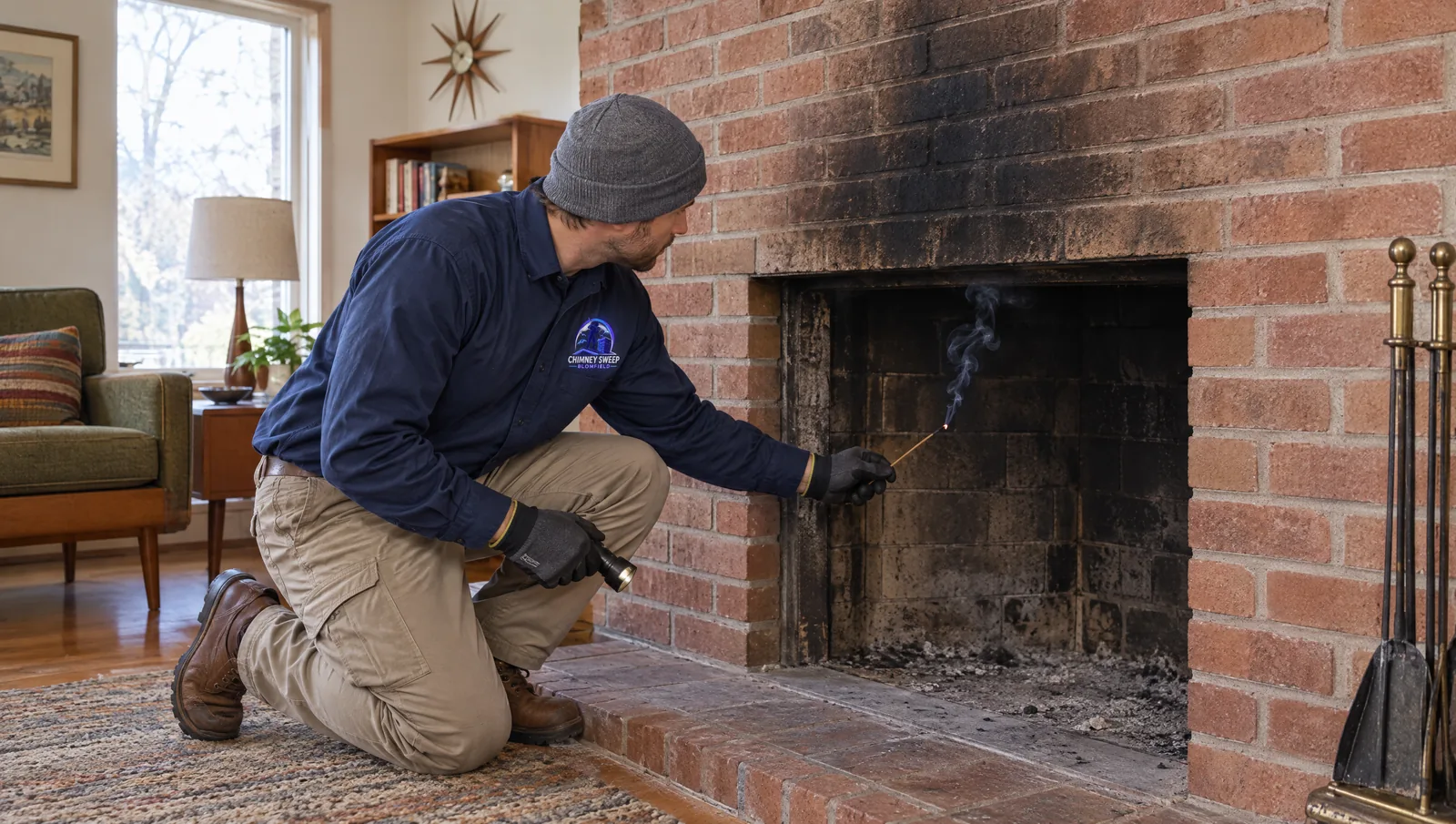
A fireplace smokes into the room when the chimney cannot pull the smoke up and out faster than the fire makes it. That is what draft means. In Cedar Grove the cause is usually one of five things: a cold flue, a blockage, a fireplace opening that is too large for its flue, a house that is pulling air down the chimney, or wind tumbling over a roof or hillside. The trick is to notice when the smoke happens, because each cause has its own timing.
Why terrain matters in Cedar Grove
Cedar Grove sits between the First and Second Watchung Mountains. The center of the township is in a valley at roughly 280 feet above sea level, many sections are well above 400 feet, and the hilltops reach 600 feet and more. A house on a slope can have the uphill neighbor's roof, a ridge or a stand of tall trees close behind it. Wind passing over those can roll down onto a short chimney and push smoke back into the flue.
The housing adds a second layer. Cedar Grove grew quickly as a suburb in the 1950s and 1960s, with the population climbing from 8,022 in 1950 to 14,603 in 1960. Houses from that era have often been updated since, with new windows, added insulation and stronger kitchen exhaust. A tighter house with a strong range hood can starve a fireplace of the air it needs. In the South End, where homes sit closer together, a taller neighboring house can also affect how a chimney draws.
Step 1: Notice when it smokes
Before anyone climbs a ladder, pay attention to the timing. Write it down for a few fires.
- Only for the first few minutes: a cold flue. The column of cold air in the chimney has to be pushed out before warm smoke can rise.
- All the time, from the first match: a blockage, heavy creosote, a closed or broken damper, or a fireplace opening that is too big for the flue.
- Only when the dryer, bath fan or range hood is on: the house is under negative pressure and pulling air down the chimney.
- Only on windy days, or with wind from one direction: downdraft from nearby roofs, trees or the slope.
- After a fire has burned down: often a cold, oversized flue or a cap that restricts flow.
Step 2: Try the simple checks
- Confirm the damper is fully open. Look up with a flashlight. A damper that only opens partway, or a handle that has slipped off its linkage, is common.
- Prime the flue. Hold a rolled sheet of lit newspaper up near the open damper for a minute before lighting the fire. If that stops the start-up smoke, a cold flue was the problem.
- Crack a window near the fireplace. If the smoke stops, the house is short of air. Turning off exhaust fans while the fire burns has the same effect.
- Burn dry wood in a smaller fire. Wet wood smolders and makes far more smoke than a chimney can handle, and an oversized fire can overwhelm even a good flue.
Step 3: What a professional looks at
If the simple checks do not settle it, the next step is an inspection. A sweep will clean the flue and look for nests, fallen debris and heavy creosote. A camera can show cracked or offset flue tiles that slow the smoke down. The smoke chamber, the sloped area above the damper, is checked too, because rough or badly shaped masonry there creates turbulence.
The chimney's height is measured against the roof. The usual rule is that a masonry chimney should rise at least three feet above where it passes through the roof, and at least two feet higher than any part of the building within ten feet. A chimney that falls short of that on a hillside lot is a prime suspect for wind problems. The fireplace opening is also compared with the size of the flue. If the opening is too large, the flue simply cannot move enough air.
Step 4: Matching the fix to the cause
Blockage or creosote: a sweep. Our Cedar Grove chimney sweep page explains what that visit includes.
Downdraft from wind or nearby roofs: a wind-directional cap, or extending the chimney so it clears the obstruction. Extending a chimney means adding courses of masonry or a properly supported flue extension, which ties into the work on our chimney rebuild page.
Opening too large for the flue: a smoke guard across the top of the opening, raising the hearth or fitting glass doors to reduce the opening. A fireplace insert with its own liner is another route.
A house that is short of air: a source of outside air near the fireplace, or simply changing habits with fans while a fire burns.
A rough smoke chamber or damaged damper: parging the smoke chamber smooth or replacing the damper. Those are covered under chimney repair.
Do not ignore a smoky fireplace
Smoke in the room is unpleasant, but the bigger concern is what comes with it. Poor draft means more creosote on the flue walls and a higher chance of carbon monoxide entering the house, especially if a furnace or water heater shares the chimney. Keep a working carbon monoxide alarm on each floor. If you have run through the simple checks and the fireplace still smokes, call us at (973) 786-9077. A Level 1 inspection is free, and a Level 2 inspection with a full camera survey of the flue is $350.
Fireplace still smoking?
We will sweep and inspect the flue, check the height and the smoke chamber, and tell you what is causing it. The estimate is free.
Chimney sweep in Cedar Grove Get a Free EstimateMore reading: why air comes down a chimney · creosote in wood-burning fireplaces